

Assignment Before Aggression: Why Assignment Is Worth 50% of Our Offensive Line Grade
In our recent article on the offensive line grading system, we explained that assignment is worth 2 points out of the 4 points available on every play, making it 50% of a player’s grade.
As we were putting that grading system together, it forced us to think about a simple question:
Why should assignment carry so much weight?
At first glance, it almost feels too important.
Offensive line coaches spend countless hours teaching stance, footwork, hand placement, leverage, and blocking technique. Those things are all critical to playing offensive line well.
The more we thought about it, however, the more we kept coming back to an observation we’ve made over the years coaching youth football. That is that young players tend to play much faster and more aggressively when they know exactly who they are supposed to block. That realization has shaped not only how we grade offensive line play, but also how we think about teaching it.
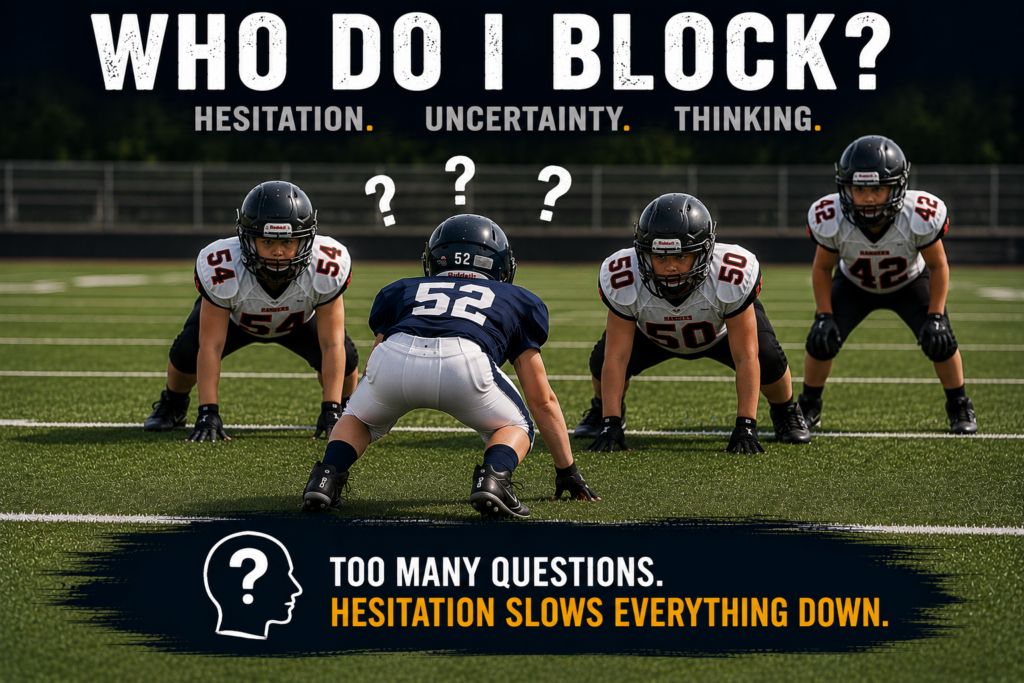
When Hesitation Looks Like a Lack of Aggression
Most youth coaches have seen it.
The ball is snapped and one lineman fires off the ball while another appears hesitant. Maybe he takes a false step. Maybe he stands upright. Maybe he simply seems slow getting to his block.
It’s easy to watch that and conclude the player isn’t aggressive enough.
Sometimes that may be true.
But we’ve found that many times the player isn’t lacking aggression at all. He’s trying to figure out who he’s supposed to block.
While one player has already identified his assignment and is attacking, another player is still processing information.
He’s asking himself:
- Is that my defender?
- Am I blocking inside?
- Am I pulling?
- Should I help my teammate?
- What happens if the defense shifts?
By the time those questions are answered, the defense is already moving.
What looks like a lack of aggression is often uncertainty.
Every Scheme Gives Players Answers
One thing we’ve come to appreciate is that every successful offensive system gives players a way to determine who they are blocking.
Some teams use Gap-On-Down rules. Others use Gap-Down-Backer concepts. Some use zone schemes, man schemes, or a combination of several approaches.
The specific system isn’t really the point.
The common thread is that each system provides players with answers before the ball is snapped.
The goal isn’t to create more rules.
The goal is to remove uncertainty.
When players have a clear process for identifying their assignment, they can stop thinking and start playing.
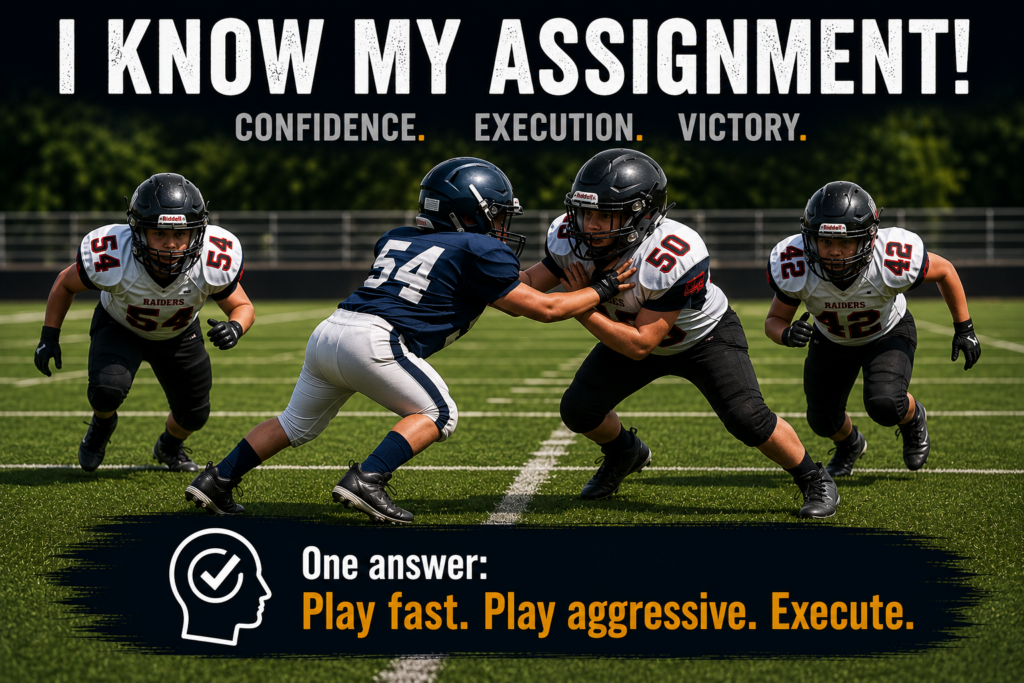
Confidence Creates Aggression
Over the years, we’ve noticed that confidence and aggression are closely connected.
When a player knows exactly who he is blocking, he tends to play faster.
His first step is more decisive.
His effort appears greater.
He plays with more conviction.
In many cases, the aggression was already there. The player simply had confidence in what he was being asked to do.
On the other hand, uncertainty naturally creates hesitation.
And hesitation often looks exactly like a lack of aggression on film.
Why Assignment Matters So Much
This is ultimately why assignment carries so much weight in our grading system.
A player can have imperfect footwork.
A player can miss with his hands.
A player can lose a physical battle against a better athlete.
Those things happen, especially in youth football.
But if the player correctly identified his assignment and attacked the right defender, we believe he has accomplished one of the most important parts of his job.
Conversely, even a technically sound block can create problems if it is delivered to the wrong defender.
Over the years, we’ve noticed that young players tend to improve much faster once they have confidence in their assignment.
When they know who they are blocking, they can focus their attention on footwork, hand placement, leverage, and effort.
Instead of trying to solve a problem after the snap, they can concentrate on executing the block.
We’ve found that this confidence often leads to faster play, better technique, and a more aggressive mindset.
Building on Our Grading System
If you haven’t read our article on grading offensive line play, this concept is a big reason assignment accounts for 50% of the total score.
You can read that article here:
Additional Offensive Line Resources
No coach has all the answers, and we’ve borrowed plenty of ideas from coaches who have been generous enough to share their knowledge over the years.
One resource we’ve found particularly valuable is Coach Parker’s offensive line section. It contains a wide variety of articles covering blocking schemes, techniques, drills, and offensive line play from a coach that values offensive line play.
Final Thoughts
As coaches, we spend a lot of time teaching technique and encouraging our players to play aggressively.
One thing we’ve noticed over the years is that confidence often serves as the bridge between the two.
When players clearly understand their assignment, they tend to play faster, trust themselves more, and execute with greater conviction.
That’s not the only reason assignment carries so much weight in our grading system, but it is certainly one of the biggest.
The better young players understand their job, the better opportunity they have to perform it successfully.