

A Simple Offensive Line Grading System for Youth Football
One thing we’ve started doing over the past few seasons is grading our offensive line play. Nothing fancy, just a simple system that helps us reinforce the things we’re already teaching.
I thought I’d share it because it may be useful for other youth coaches looking for a quick way to evaluate offensive line play.
Like most youth coaches, I don’t have unlimited time to spend grading film. I wanted something simple enough that I would actually use it every week while still providing meaningful feedback to our players.
A few years ago, I wanted a simple way to identify what our offensive line was doing well and where we needed to improve.
When I sat down to create the grading system, I started with a simple question:
What are the three things we talk about most with our offensive linemen?
For us, the answer was:
- Assignment
- Get Off
- Finish
So that’s exactly what we grade.
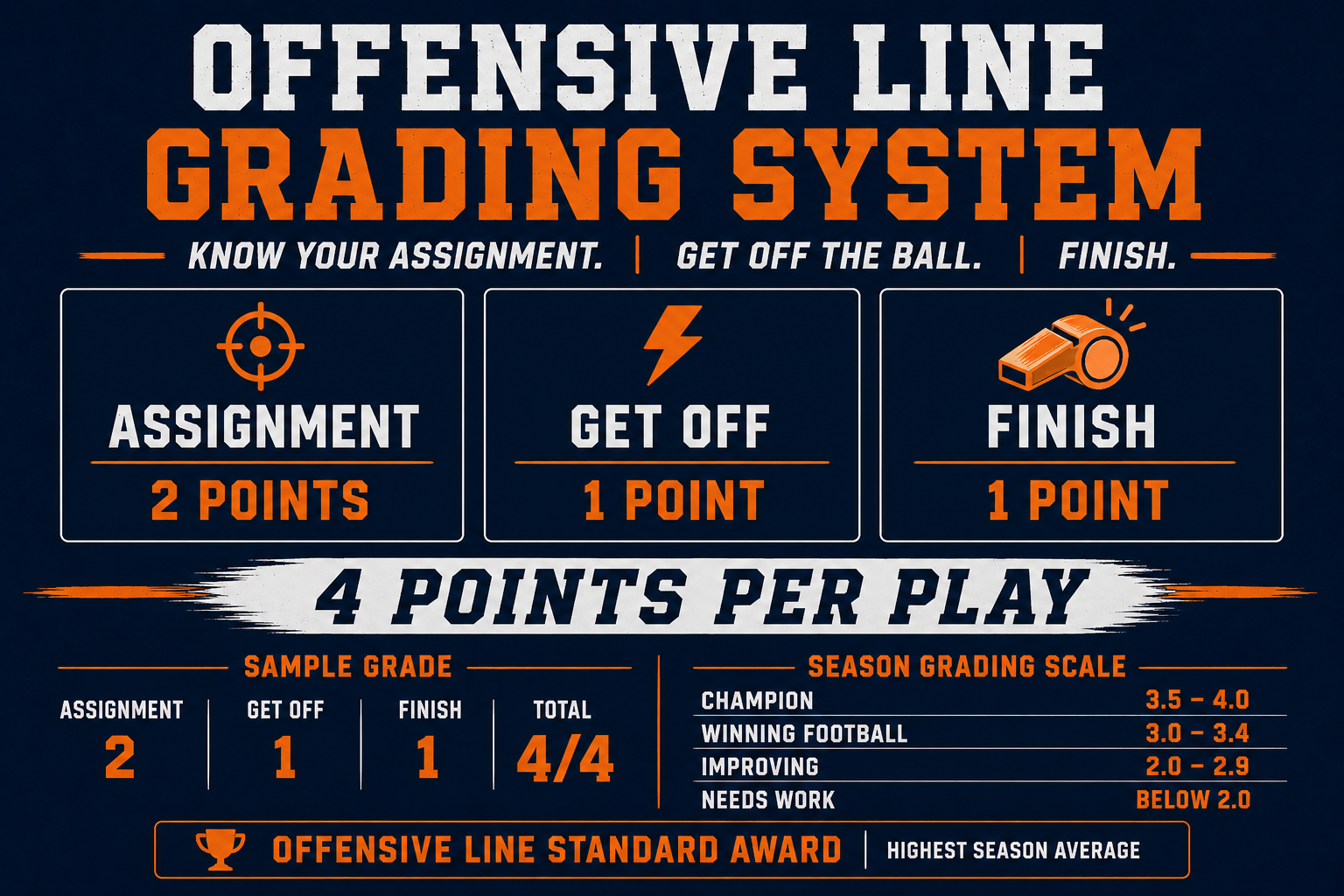
The Grading System
Each player can earn up to four points per play.
Assignment (2 Points)
Assignment is the most important part of the grade.
Did the player block the correct defender?
Regardless of the scheme you’re running, offensive linemen need to know who they’re responsible for blocking.
A player can have great effort and great technique, but if he’s blocking the wrong defender, the play is probably not going to be successful.
Because of that, assignment is worth two points, or half of the total grade.
Get Off (1 Point)
Did the player get off the ball?
We stress getting off the football every day in practice. A good first step puts players in position to be successful and often covers up a lot of mistakes.
This category is simply rewarding players for playing with urgency.
Finish (1 Point)
Did the player finish the block?
We’re looking for players who stay engaged, keep their feet moving, and compete through the whistle.
Not every finish results in a pancake block, but we want our linemen developing the habit of straining to finish every play.
Why We Like It
The biggest reason I like this system is its simplicity.
After a game, I can quickly work through the film and grade every offensive snap without spending hours trying to track a dozen different categories.
More importantly, the players understand it.
They know exactly what we’re looking for because the grading categories match the things we’re coaching every day at practice.
There is no mystery.
Know your assignment.
Get off the ball.
Finish.
Another benefit is consistency between coaches. When everyone understands that we’re grading Assignment, Get Off, and Finish, it helps align what we’re teaching and what we’re emphasizing during practice.
Grading Execution, Not Results
One thing I like about this system is that we’re grading the player’s execution, not the result of the play.
A lineman can do everything right and still have a play fail because of a missed block elsewhere, a bad read, a fumble, or simply a good play by the defense.
Likewise, a player can miss an assignment and still end up on a successful play because a talented running back made someone miss.
We want our players focused on doing their job.
If they consistently know their assignment, get off the ball, and finish, good things usually happen.
Sample Grading
Let’s say an offensive lineman knows his assignment, gets off the ball quickly, and stays engaged through the whistle.
Assignment: 2 points
Get Off: 1 point
Finish: 1 point
Total: 4 out of 4
On the next play, maybe he gets off the ball and finishes, but blocks the wrong defender.
Assignment: 0 points
Get Off: 1 point
Finish: 1 point
Total: 2 out of 4
The system is simple, but it gives players a clear picture of what they’re doing well and where they need to improve.
Interpreting the Scores
We use the following ranges when evaluating performance:
- 3.5 – 4.0: Champion
- 3.0 – 3.4: Winning Football
- 2.0 – 2.9: Improving
- Below 2.0: Needs Work
The goal isn’t perfection. The goal is identifying strengths and areas for improvement while giving players a clear understanding of the standard we’re striving for.

The Offensive Line Standard Award
One thing we’ve started doing with the grading system is tracking scores throughout the season.
At the end of the year, we recognize the offensive lineman who maintained the highest average grade with our Offensive Line Standard Award.
I like this approach because it rewards consistency.
The award isn’t necessarily given to the biggest player, the strongest player, or even the player with the most highlight-reel blocks.
It’s given to the player who consistently does the things we value most: knowing his assignment, getting off the ball, and finishing.
For our players, it provides a clear standard to strive for throughout the season and reinforces the importance of doing their job on every snap.
Final Thoughts
One unexpected benefit of grading our offensive line is that it has improved our coaching.
Rather than saying, “We need to block better,” we can identify exactly where we’re struggling. Are we missing assignments? Are we slow getting off the ball? Are we failing to sustain blocks?
The grading gives us a simple way to measure the things we’re emphasizing and helps keep both coaches and players focused on what matters most.
This certainly isn’t the only way to grade offensive line play, but it’s worked well for our program.
If you’re looking for a straightforward way to evaluate offensive line play, feel free to borrow it and adapt it to fit your own coaching philosophy.
At the end of the day, the goal isn’t the spreadsheet.
The goal is helping young offensive linemen understand what success looks like, giving coaches a simple tool to help them improve, and establishing a clear standard for offensive line play within your program.